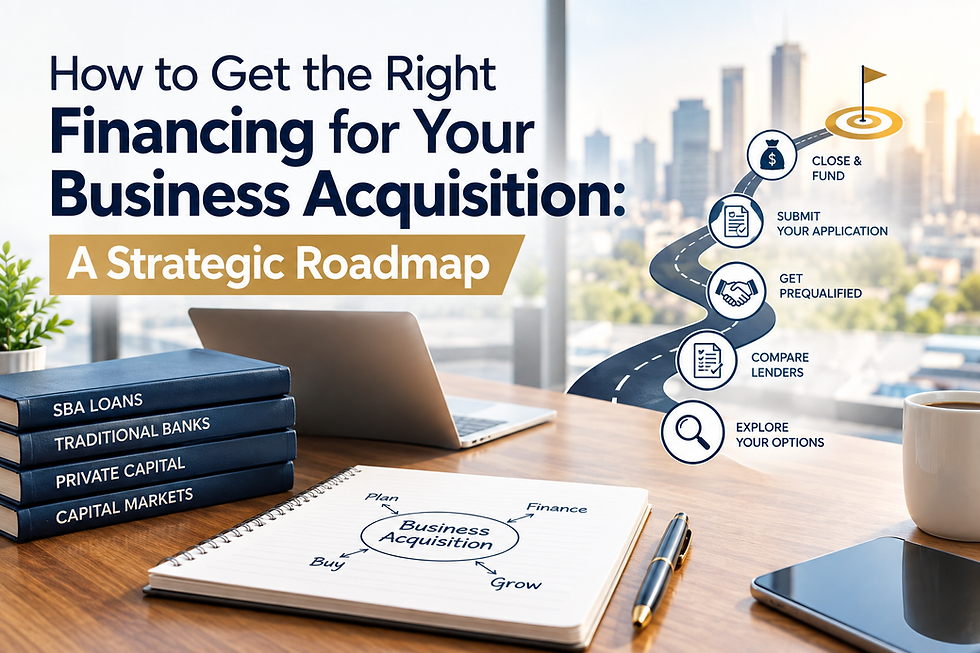
How to Get the Right Financing for Your Business Acquisition: A Strategic Roadmap

I've watched too many entrepreneurs lose their dream acquisitions because they chose the wrong financing path. They'd find a perfect business, get excited, then realize halfway through the process that their lender was slow, expensive, or worse—not interested in acquisition deals at all. By then, the seller had moved on to another buyer.
Getting the right business acquisition financing isn't just about finding money. It's about finding the right money at the right time with the right terms. That's what separates deals that actually close from deals that fall apart.
I'm going to walk you through exactly how to think about this so you don't end up in that situation.
Understanding Your Financing Options Before You Start Shopping
Here's my first piece of advice: don't fall in love with a business before you understand your financing options. Sounds backward, I know. But this is how it works in the real world.
Most people approach acquisition backwards. They find a business they love, negotiate a purchase price, then figure out how to pay for it. That's when they panic. That's when they settle for terrible terms because they feel stuck.
Instead, spend a few weeks mapping out your actual financing options before you even start seriously looking. Meet with three or four lenders. Not to apply yet, just to understand what you qualify for, what rates look like, what timeline you're looking at.
When I do this exercise with buyers, they usually discover they can borrow way more than they thought. Or sometimes less. Either way, knowing your number before you start looking changes everything. You can make intelligent offers. You negotiate from strength instead of hope.
Business acquisition financing comes in multiple flavors. sba 7(a) loans for business acquisitions are common, but so are conventional bank loans, asset-based lending, seller financing, and combinations of all three. Each has different approval timelines, interest rates, collateral requirements, and flexibility. You won't know which makes sense for your situation until you do some homework.
The Hidden Costs Nobody Tells You About in Acquisition Financing
This is where lenders get you if you're not paying attention. The interest rate is just one piece of the puzzle, and honestly, it's not even the most expensive piece sometimes.
Let's talk real numbers. You're looking at origination fees (usually 1-3% of the loan amount), appraisal fees ($2,000-$5,000), SBA guarantee fees if you go that route (another 2-3.5%), due diligence costs, legal fees to review the purchase agreement, accounting fees to analyze the seller's financials. By the time you close, you might have paid $15,000-$30,000 before you've even opened the doors.
I worked with a buyer recently who got quoted 7.5% interest on an SBA loan and felt great about it. But when we calculated all the fees, the true cost of borrowing was closer to 9%. Still good, but not as good as it looked at first glance.
Then there's the time cost. If your lender takes 120 days to close and you lose the deal to someone with faster capital, no interest rate was low enough. Speed matters. Terms matter. Flexibility matters.
You also need to think about personal guarantees. Almost every acquisition loan requires you to personally guarantee the debt. That means if the business fails, they can come after your personal assets. That's a real cost in the form of personal risk. Some lenders are easier on this than others.
Why Choosing the Wrong Lender Can Cost You Thousands
Not all lenders are created equal, especially when it comes to acquisitions. Some banks have entire departments dedicated to acquisition financing. Others treat it like a sideshow. You want the specialists.
I've seen lenders kill deals because they didn't understand the acquisition market. They'd apply normal business lending standards to an acquisition and miss the obvious. Or they'd move so slowly that the seller got impatient and sold to someone else.
There's also the issue of lender appetite. Some banks are flush with capital and hungry to do deals. Others are tightening up. Timing matters. A lender who turned you down last year might be actively competing for deals this year, and vice versa.
The cheap rate doesn't always win. I've had buyers choose a lender based on price alone, then spend the next six months fighting through underwriting while a more expensive lender would've closed in 60 days. Do the math on your timeline before you choose.
The Personal Financial Statement: What Lenders Really Want to See
Your personal financial statement is your financial autobiography. Lenders will dissect it. They want to see:
How much liquid cash you have sitting around. This signals you can weather problems. They like to see at least 20% down from the buyer plus reserves equal to six months of the loan payment. So on a $300K acquisition with a $240K loan, they want you to have $60K down plus $12,000 in reserves (if payments are $2,000/month). That's $72,000 of your own money exposed.
Your credit history, obviously. But more than your score, they care about recent negative marks. A bankruptcy from ten years ago? Probably fine if you've been clean since. A missed payment from six months ago? That's a problem.
Your income and employment stability. Even though the business is being acquired and will service its own debt, lenders want to know you're stable. If you're self-employed or a contractor, they'll want two years of tax returns. If you're changing jobs to buy this business, they'll want a letter from your new employer confirming employment.
Your existing debt load. How many mortgages do you have? Car loans? Credit cards? High utilization on credit cards signals financial stress. Lenders run your debt-to-income ratio and that matters.
Most people show up at a lender's office unprepared and then act surprised when the lender wants more documents. Get your personal financial statement clean and organized before you approach any lender seriously.
Negotiating Seller Financing—The Leverage You Didn't Know You Had
Here's where most buyers miss a huge opportunity. The seller usually has leverage you can't see from the outside.
Think about it from the seller's perspective. They've built this business over years. They could shut the doors and do nothing, but they probably want to cash out. They're tired. They want to move on. That's where your power lives.
When the seller agrees to finance part of the deal, they're taking risk. They're saying "I believe this business will succeed under your ownership enough that I'll wait to get paid." That signal matters tremendously to bank lenders. Suddenly your deal looks safer because even the person who knows it best is betting on you.
I usually structure deals where the seller finances 10-20% of the purchase price and the bank finances the rest. This gives the seller some ongoing interest in the business's success (they get paid when it profits) and signals confidence to the bank.
The negotiation happens during the purchase agreement phase. If you haven't started that conversation before talking to lenders, you're working backwards. Have the conversation early. Find out if the seller's willing to hold paper. That changes what's possible with bank financing.
Red Flags That Signal a Bad Financing Deal
Trust your gut when something feels off. I've seen buyers ignore warning signs and regret it badly.
Watch out for lenders who seem too eager. If they're offering incredible rates with minimal documentation, there's usually a catch. Maybe they're structuring the loan in a way that looks good now but explodes later. Maybe they're adding hidden fees. Maybe they're just inexperienced and don't understand the risk.
Be suspicious of lenders who don't ask detailed questions about the business you're acquiring. They should want to understand cash flow, growth patterns, customer concentration, industry trends, competition. If they rubber-stamp your application without diving deep, that's a red flag.
Also watch out for lenders who rush you. Acquisition financing requires time to do right. If a lender is pushing you to close in two weeks, they either don't understand acquisitions or they're cutting corners. Neither is good for you.
And pay attention to the personal guarantee terms. Some lenders will eventually release the personal guarantee after five years if you've paid on time. Some won't, ever. That's worth negotiating about upfront. It's not a deal-killer usually, but it's worth understanding what you're signing.
Building Your Acquisition Financing Roadmap
This is the strategic piece that separates successful acquisitions from failed ones. You need a plan before you start executing.
Start by answering these questions honestly: How much can I realistically put down as a down payment? How much time do I have to find and close on a business (30 days, six months, a year)? What size acquisition am I targeting ($250K, $500K, $1M+)? How comfortable am I with personal risk?
Next, research your market. What are lenders offering right now? What are typical terms and rates for your acquisition size? What's the timeline? Call three to five lenders and just ask questions. You're not applying yet; you're gathering intelligence.
Then, build your personal financial story. Clean up your credit if needed. Get your tax returns organized. Have your accountant prepare a clean personal financial statement. This is your entrance fee to the financing game.
Finally, create your target profile. What kind of business are you looking for? What's your maximum price? What industries interest you? Why? This clarity helps when you're talking to lenders because you can show them you're serious and thoughtful, not just chasing any deal.
Common Mistakes Buyers Make When Seeking Acquisition Funding
I see these repeatedly, and they're usually avoidable.
First: approaching only one lender. Shop around. Different lenders have different appetites, rates, and terms. You might get quoted 8.5% from one and 7.2% from another for the same deal. That's a huge difference over ten years.
Second: waiting too long to engage lenders. You should start the relationship weeks before you make an offer. Get pre-qualified. Understand what you can borrow. Then when you find the right business, you can move fast.
Third: not negotiating with the seller early. By the time you're trying to finance the deal, the seller's already moved on emotionally or to another buyer. Have seller financing conversations before you're locked into the deal.
Fourth: overestimating how much the business will earn after acquisition. Lenders are conservative and for good reason. If you project the business will grow 50% in year one, they'll question your assumptions. Stick to conservative numbers that you can defend.
Fifth: trying to hide financial problems. If you have a bankruptcy from eight years ago, just disclose it. Lenders know how to assess old issues. When you hide stuff and they find it later, that's a trust-killer.
When to Walk Away From a Deal
This is the hardest one to write about because I know how it feels to fall in love with a business. But sometimes walking away is the smartest move.
Walk away if the numbers don't work. If the business can barely service its debt after acquisition, you're setting yourself up for failure. Just because you can get a loan doesn't mean you should.
Walk away if the seller won't cooperate on financing. That's a signal they don't believe in the business's future. Listen to that signal.
Walk away if your lender is being unreasonable. If they're adding conditions that don't make sense or dragging their feet for no reason, find a different lender. There's always another deal.
Walk away if you haven't done proper due diligence. Never, ever let timeline pressure force you to skip financial analysis. A good acquisition financing partner will tell you to slow down and get it right.
Making Your Offer Irresistible to Both Seller and Lender
This is the art part. You want to structure your offer so that it works for everyone.
From the seller's perspective, you want to show you're serious, stable, and capable. That means putting down solid down payment money (10-20%), having your financing pre-approved, and moving fast through due diligence. Sellers trust buyers who are organized and prepared.
From the lender's perspective, you want to show that this is a solid deal being executed by a smart buyer. That means clean financials, reasonable growth projections, experienced leadership (yours), and a plan for the first 100 days of ownership.
When you can write an offer that shows you've thought this through—that you understand the business, you've lined up financing, you have a transition plan—suddenly you're the buyer sellers want to work with. And that confidence flows to the lender too.
FAQ
How long does it take to get approved for business acquisition financing?
Typically 60-90 days from application to funding. The SBA portion adds time but gets you better rates. Some conventional lenders move faster—maybe 30-45 days—but at a higher cost.
Can I get acquisition financing if I don't have a business background?
Yes, but it helps to have something. A track record in the industry you're acquiring into matters. So does having a co-buyer or advisor with relevant experience. Lenders want to see you're not completely green.
What happens if the seller won't finance part of the deal?
You'll need a bigger down payment from your own cash. Or you'll need to find a cosigner. Or you'll need to look at alternative lenders like asset-based lenders or private money sources. It's harder, but not impossible.
Should I get a business broker involved in the acquisition?
Brokers can help you find deals and navigate negotiations, but they're not required. They typically take 5-10% of the purchase price as commission. Some lenders actually like seeing a broker involved because it signals professionalism. Others don't care.
What if my personal credit isn't perfect?
It's tougher but not impossible. Focus on the business's financials and cash flow. Show the lender that this acquisition makes sense regardless of your credit situation. Be transparent about any credit issues and explain them.
Getting Started on Your Acquisition Journey
The right business acquisition funding can mean the difference between a deal that closes smoothly and one that falls apart. It's about finding a financing partner who understands your situation, moves at your speed, and believes in your vision.
At YAW Capital, we specialize in helping entrepreneurs find the right financing structure for their acquisitions. We've built relationships with lenders who understand this market. We know what questions to ask. We know how to position your deal for approval.
If you're serious about acquiring a business, let's have a conversation about what's possible in your situation.

Comments